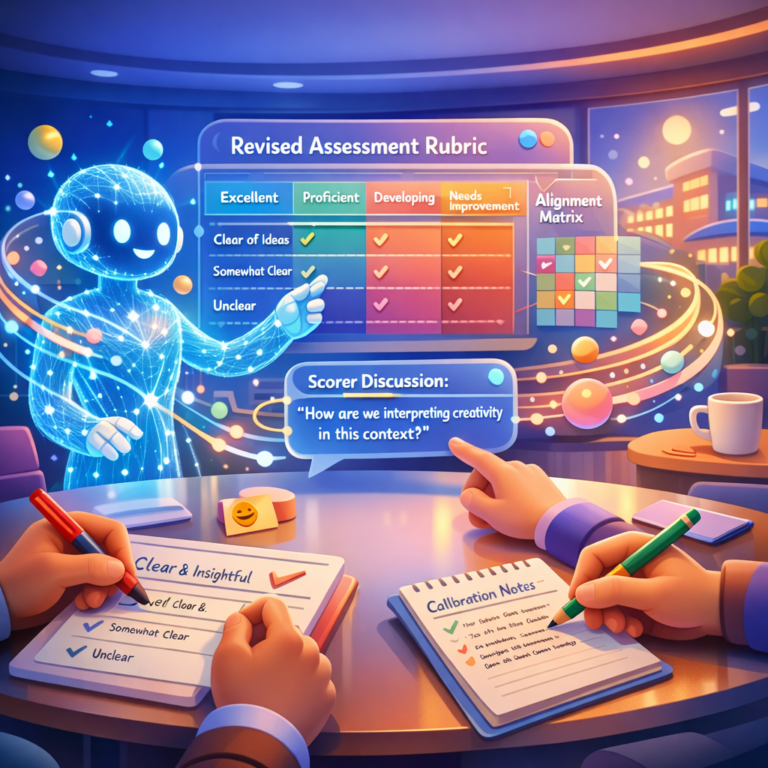
⚡️Assessment Unlocked: Smarter Rubrics, Better Evidence

Rubrics are having a moment again, and for good reason. In a GenAI environment, many programs are rechecking what they ask students to do, how they define quality, and whether their scoring language still captures the learning they care about.
Audience: Assessment coordinators, faculty leads, and program directors | Mode: Workflow week | Level: Intermediate
📌 Why this matters now
Rubrics sit at the center of program assessment, course assessment, and improvement conversations. They translate broad outcomes into observable performance. That matters even more now, because GenAI has exposed weak prompts, vague criteria, and uneven scoring habits that were easy to ignore when student work looked more predictable. Recent higher ed guidance also shows that institutions are actively building AI policies and support structures, but confidence is still uneven, especially around responsible educational use.
Do this next: pick one rubric your program already uses and ask a small faculty group one question, “Which criterion is hardest to score consistently?” Start there.
📚 What the field already knows
Assessment professionals have known for a long time that stronger evidence starts with clearer expectations. AAC&U’s VALUE rubrics were built as faculty-developed frameworks for evaluating authentic student work, and AAC&U’s related calibration and assignment tools are designed to help institutions interpret criteria more consistently and connect assignments to learning outcomes. In other words, the field has not been waiting for AI to discover good rubric practice; shared standards, authentic evidence, and scorer calibration were already central ideas. (AAC&U VALUE; AAC&U Calibration Training).
More recent work on GenAI adds a useful layer, not a replacement. An EDUCAUSE article on course design notes that instructors can use GenAI to refine learning objectives, align them to Bloom’s cognitive levels, draft assessment ideas, and even generate a first-pass rubric draft, but the output still needs human review and revision. That is a good summary of the moment we are in: AI can help teams move faster past writer’s block, but it cannot decide what quality means in a discipline, a program, or an institutional context. (EDUCAUSE Review, 2024)
The governance side is also becoming clearer. The 2025 EDUCAUSE AI Landscape Study describes a higher ed environment still grappling with AI strategy, leadership, policy, workforce questions, and institutional divides. UNESCO reported in September 2025 that nearly two-thirds of surveyed higher education institutions already had AI guidance or were developing it, while confidence about effective and ethical use remained uneven. A recent EDUCAUSE framework on transparency argues that documentation and disclosure matter because invisible AI use can weaken trust. AALHE and the Massachusetts GenAI in Assessment Guidebook both push in the same direction: assessment professionals should lead thoughtful integration, with integrity, inclusivity, rigor, and human judgment at the center. (EDUCAUSE, 2025; UNESCO, 2025; Damm & Eaton, 2026; Miller, 2024)
References
- AAC&U. VALUE Rubrics; VALUE Calibration Training; VALUE Assignment Design and Diagnostic Tool.
- EDUCAUSE. 2025 EDUCAUSE AI Landscape Study.
- EDUCAUSE Review. Augmented Course Design: Using AI to Boost Efficiency and Expand Capacity (2024).
- EDUCAUSE Review. From Prompt to Practice: A Framework for Transparent GenAI Use in Higher Education (2026).
- UNESCO. Guidance for Generative AI in Education and Research and 2025 survey summary on institutional AI guidance.
- Miller, W. Adapting to AI: Reimagining the Role of Assessment Professionals (AALHE, 2024).
- Massachusetts public higher education guidebook. GenAI in Assessment: A Practical Guidebook (2025).
🤖 Where GenAI helps and where it does not
Used well, GenAI is very good at three rubric-support tasks.
First, it can help a faculty team tighten language. If a criterion says “demonstrates understanding,” AI can suggest more observable wording such as “explains relationships among concepts,” “applies the method to a new case,” or “evaluates competing interpretations using evidence.” That saves time during rubric revision.
Second, it can help teams check alignment. If you paste in a CLO, assignment prompt, and rubric draft, AI can flag obvious mismatches. For example, it may notice that the outcome calls for analysis but the rubric mostly rewards summary.
Third, it can help with calibration prep. You can ask AI to create short scorer notes, examples of borderline performance, or discussion questions for a norming session. EDUCAUSE’s recent transparency guidance is especially useful here; if AI supported the draft, teams should document that use clearly rather than treating it as invisible background help.
Where GenAI does not help is just as important. It should not be the authority that defines disciplinary quality. It should not score high-stakes student work on its own. It should not replace faculty discussion about standards, or quietly introduce vague, generic, or biased language into a rubric. UNESCO and EDUCAUSE guidance both point to uneven confidence, ethical concerns, and the need for transparency and governance. That means the safe pattern is support, review, revise, document, and then test with humans.
A good use looks like this: a faculty team asks AI for three alternate phrasings of a rubric criterion, then chooses and edits one. Another good use: an assessment coordinator asks AI to generate practice scoring rationales for a norming session, then the team critiques them. A poor use looks like this: a program uploads student work to a public tool, lets AI assign scores, and treats those numbers as assessment evidence without faculty review.
Do this next: use AI only on the rubric draft first, not on student submissions. That lowers risk and keeps the conversation focused on standards.
🚩 Red flag
Red flag
If your team uses GenAI to “finish the rubric quickly” and skips the faculty conversation about what counts as quality, you did not save time. You only postponed the hard part. A better path is to use AI for drafting options, then let faculty decide, edit, and calibrate the final language together.
🧭 Expert playbook
| Action | Why it matters | Next step |
|---|---|---|
| Start with one outcome, not the whole rubric | Teams get better results when they revise one criterion at a time | Choose the outcome with the most inconsistent scoring |
| Give AI your local context | Generic prompts produce generic rubrics | Include the CLO, assignment, discipline, student level, and current rubric |
| Ask for observable performance language | Rubrics improve when criteria describe what scorers can actually see | Prompt for verbs tied to analysis, application, evaluation, or design |
| Generate contrast cases | Borderline examples are gold for calibration | Ask AI to describe what “meets” vs. “approaches” looks like |
| Run a human norming session | Reliability improves through discussion, not automation | Score 3 to 5 artifacts together and record decisions |
| Document AI use | Transparency protects trust and helps later revision | Add a short note in your assessment records about where AI was used |
Best practice takeaway: the strongest workflow is faculty-owned, AI-assisted, and documented.
⚠️ Common mistakes to avoid
Mistake 1: Starting with the tool instead of the outcome
Fix: begin with the CLO or PLO and the assignment students complete. Then ask whether the rubric reflects that target.
Mistake 2: Accepting polished wording too quickly
Fix: ask, “Could two faculty scorers interpret this criterion differently?” If yes, revise again.
Mistake 3: Treating AI-generated levels as valid by default
Fix: test the draft on real or sample student work before adopting it.
Mistake 4: Using public tools with sensitive student material
Fix: revise rubrics with de-identified examples or synthetic samples unless your institution has approved secure tools and guidance. UNESCO, EDUCAUSE, and recent assessment guidance all push institutions toward clearer governance and responsible use.
Mistake 5: Skipping calibration because the rubric “looks clearer now”
Fix: clarity on paper is not the same as scoring consistency. Hold the norming session anyway.
🏫 Case illustration
A sociology program at a regional public university was preparing for its annual program assessment review. Faculty had a long-running rubric for evaluating community-based research briefs, but every year the scoring conversation got stuck on one criterion, “critical analysis.” Some faculty rewarded the amount of theory included. Others cared more about how well students connected evidence to a local problem. The scores drifted, and the closing-the-loop discussion never got very far because no one fully trusted the pattern.
The assessment coordinator proposed a small experiment. Instead of revising the entire rubric, the faculty agreed to focus on just that one criterion. They pasted the CLO, assignment prompt, and current rubric language into a campus-approved GenAI tool and asked for five alternative versions of the criterion, each written in more observable language. The tool returned options that separated summary from analysis, and analysis from evidence-based judgment.
That was helpful, but not decisive. Faculty still had to choose what mattered most for their students. One proposed version rewarded disciplinary vocabulary but still did not say enough about evidence use. Another was clearer, but too advanced for a sophomore-level course. The team combined pieces of two drafts, then asked the tool to generate short descriptions of what “approaches expectations,” “meets expectations,” and “exceeds expectations” might look like in student work.
At the next norming session, faculty scored four anonymized papers using the revised language. The real value showed up there. They found that one level still blurred “good explanation” and “strong analysis,” so they changed the descriptor again. By the end of the meeting, they had a rubric that felt more local, more teachable, and easier to score consistently.
The friction point was not the technology. It was faculty deciding what quality meant in their own curriculum. GenAI helped them get to that conversation faster, but it did not replace the judgment work that made the rubric worth using.
🛠️ Tool of the week
This week’s tool is not a brand so much as a rubric-revision prompt pattern inside your institution’s approved GenAI environment.
What it is: a structured prompt that asks AI to revise rubric language using a specific learning outcome, assignment context, student level, and performance scale.
Why it fits: it saves faculty time on drafting while keeping the important decisions in faculty hands.
Starter use case: revise one weak criterion in a program rubric, then generate borderline performance descriptions to use in calibration.
One caution: do not paste identifiable student work into a public model unless your institution explicitly allows it and has guidance in place.
🧪 Copy and try
Copy and try
You are helping a faculty team revise one rubric criterion for program assessment.
Context: [paste CLO or PLO], [paste assignment prompt], [student level], [discipline].
Current criterion: [paste current wording].
Task:
- Rewrite this criterion in 3 clearer, more observable ways.
- Keep the language appropriate for [student level].
- Show how each version aligns to the outcome.
- Draft short descriptors for three performance levels: approaching, meeting, and exceeding expectations.
- Flag any wording that could lead to inconsistent scoring or weak validity.
Do not score student work. Do not invent standards outside the context provided.
✅ What to do this week
- Pick one rubric criterion that faculty regularly interpret differently.
- Run the criterion through the prompt above and bring two revised versions to a short faculty meeting.
- Test the preferred version on three sample artifacts before using it in a full assessment cycle.
💬 Question of the day
Where is your program losing the most assessment quality right now: in the assignment, in the rubric language, or in the scoring conversation?
📣 Call to action
Choose one existing rubric this week and run a 30-minute faculty review focused on a single criterion. Small revisions here often improve the quality of your evidence more than a full template overhaul.
Subscribe for weekly tips at https://horizonsanalytics.com/subscribe
About this series
Assessment in Higher ed is a weekly Horizons Analytics series for professionals working in higher education assessment, learning outcomes, improvement, and responsible GenAI use. Each post is built to give busy teams one practical idea they can use right away, while keeping rigor, faculty ownership, and evidence quality in view.

Dr. Alaa Alsarhan is a higher education leader and analytics expert specializing in assessment, learning outcomes, and data-informed decision-making. He is CEO & Co-Founder of Horizons Analytics, a consultancy advancing AI-powered assessment and strategic planning in education and business. Dr. Alsarhan has authored multiple publications, delivered national keynotes, and led innovative research on high-impact practices, student success, and AI in higher education. He is a founding member of the GenAI in Higher Education Assessment Community of Practice and a fellow with the NWCCU Mission Fulfillment and Sustainability program.
View All Articles