
Cognitive alignment without textual or evidentiary alignment

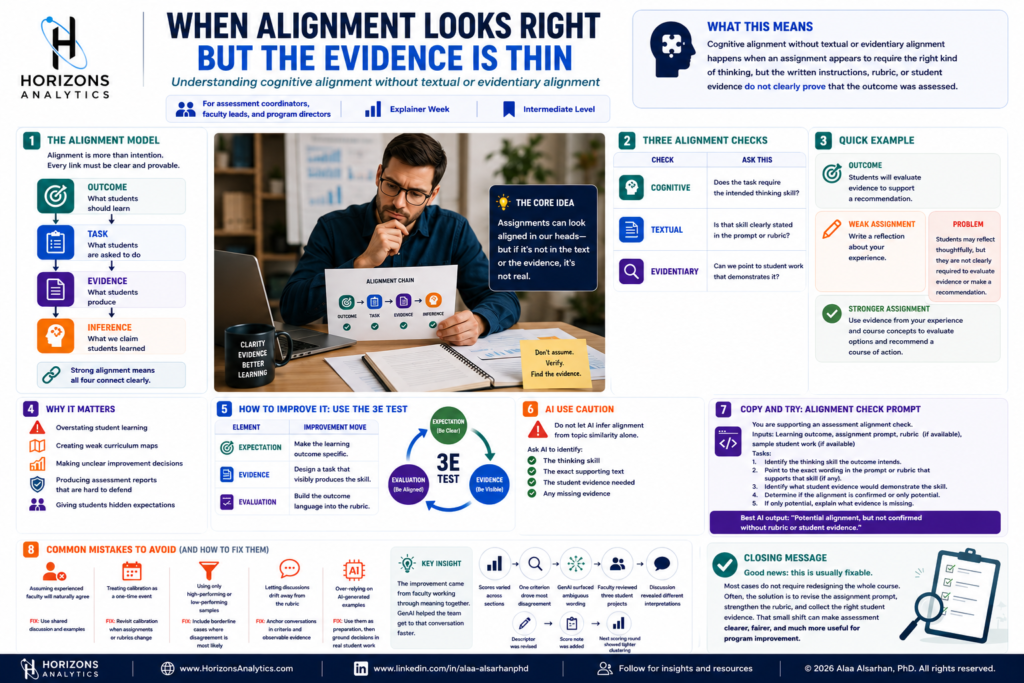
Most assessment designs look aligned.
But here’s the uncomfortable question…
Where is the evidence?
I’ve been seeing a pattern across programs:
Assignments that appear to target the right thinking, but don’t clearly produce evidence of it.
This is what I call:
Cognitive alignment without evidentiary alignment.
Everything feels right…
Until you try to prove student learning.
That’s where things break.
A simple check I’ve been using:
Does the task require the skill?
Is the skill clearly stated?
Can you point to actual student work that demonstrates it?
If any of those are unclear, alignment is only assumed, not demonstrated.
The good news?
This is usually fixable without redesigning the entire course.
Often it comes down to:
sharpening the assignment prompt
tightening rubric language
making the evidence visible
I put together a visual breakdown of this idea in the infographic below.
Curious how others are seeing this show up in their programs.
Where have you noticed alignment that looks right but doesn’t hold up under evidence?

Dr. Alaa Alsarhan is a higher education leader and analytics expert specializing in assessment, learning outcomes, and data-informed decision-making. He is CEO & Co-Founder of Horizons Analytics, a consultancy advancing AI-powered assessment and strategic planning in education and business. Dr. Alsarhan has authored multiple publications, delivered national keynotes, and led innovative research on high-impact practices, student success, and AI in higher education. He is a founding member of the GenAI in Higher Education Assessment Community of Practice and a fellow with the NWCCU Mission Fulfillment and Sustainability program.
View All Articles