🎓 Assessment Unlocked: Find the Evidence That Counts

🎬 1. The campus moment
Your curriculum map says the capstone is where students “master” critical analysis. Good. Now someone asks the question that changes the meeting: What student work would actually let us see that?
The folder contains final grades, presentation scores, papers, discussion posts, reflection surveys, and a capstone rubric. There is plenty of data. There is much less agreement about which pieces support a claim about the program learning outcome.
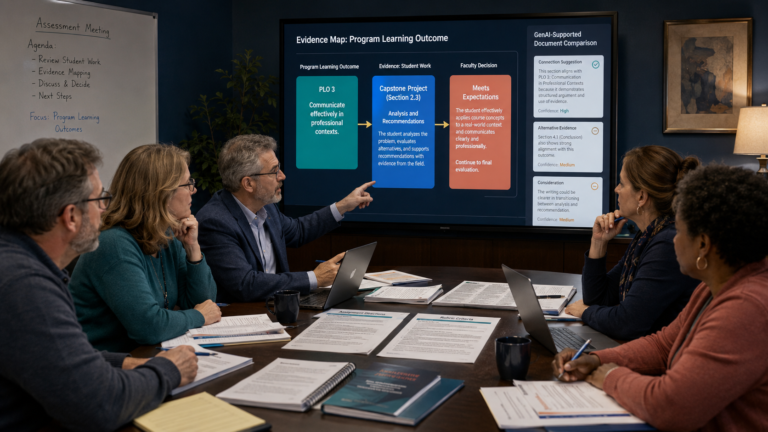
GenAI can help sort those materials, compare them with the outcome, and identify possible evidence sources before the meeting. But it can’t decide whether a piece of student work is valid evidence of the learning you intended to assess.
By the end of this issue, you’ll have a practical way to move from a curriculum map to a defensible evidence map.
- We know where an outcome is assessed, but not which artifact should be reviewed.
- We sometimes use course grades as evidence of a specific program outcome.
- We collect more student work than faculty have time to examine.
- Our assessment report contains results but doesn’t clearly connect them to a decision.
Three or more YES answers? This issue was written for your next meeting.
🧠 2. The idea in plain English
An evidence map connects a learning claim to the student work, performance, or other direct evidence that could support that claim.
Direct evidence lets you observe what students actually demonstrate. UC Davis describes it as evidence from student products or performances that shows knowledge or skills and the degree to which students have moved toward faculty-defined expectations.
Here’s the distinction that often causes trouble: an assignment isn’t automatically evidence simply because students completed it.
Imagine a capstone presentation worth 100 points. Twenty points measure visual design, twenty measure delivery, twenty measure citation format, and forty measure analysis. The total presentation score doesn’t isolate analytical reasoning. The analytical portion of the rubric and the corresponding student work may.
Think of an evidence map as a chain of custody. You should be able to trace a conclusion about learning back to the specific student performance that supports it.
The question isn’t “What data do we have?” It’s “What evidence would support this particular claim about learning?”
🔗 3. The evidence chain
Continue with our public health program from the previous issue.
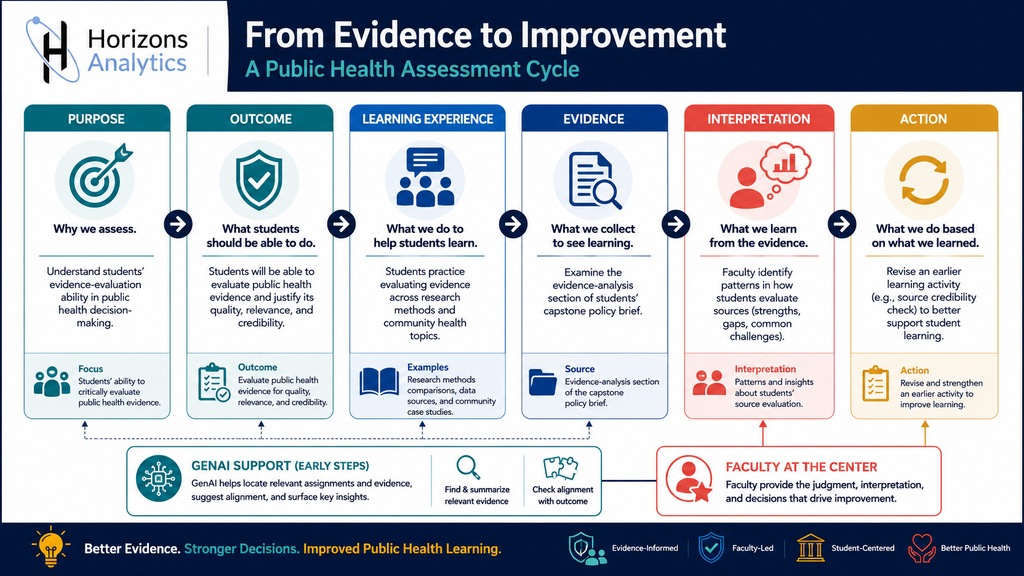
Notice what’s missing: final course grades.
Grades have legitimate purposes, but a grade often combines attendance, quizzes, projects, participation, writing quality, and several learning outcomes. It may be too broad for a specific program-level claim.
Evidence becomes useful only when someone knows what decision it should inform.
🔄 4. From available data to useful evidence
| Weak approach | Why it falls short | Stronger approach | What improves |
| Use final capstone grades | Grades combine several performances | Review the section of student work tied to the outcome | Validity |
| Collect every assignment | Volume creates scoring work without a clear purpose | Select the strongest aligned evidence source first | Workload |
| Ask AI which assignments “prove mastery” | AI doesn’t know whether students actually demonstrate the outcome | Ask AI to identify candidate evidence and explain the match | Human judgment |
| Report one rubric average | The average hides what students can and can’t do | Examine criterion-level patterns and examples | Interpretability |
This change sounds small, but it alters the assessment process. You stop asking faculty to collect everything “just in case.” Instead, the team starts with the learning claim and works backward to the evidence.
That also makes GenAI more useful. A model can scan assignment directions, rubrics, outcomes, and curriculum documents quickly. Its job is to narrow the search. Faculty decide what counts.
📋 5. The practical toolkit
Use the CLAIM Evidence Map to move from a program outcome to an evidence source.
CLAIM EVIDENCE MAP

C - CLAIM

Program learning outcome:
____________________________________

Specific learning claim we want to examine:
____________________________________

Decision this evidence should inform:
____________________________________


L - LOCATE

Courses where the outcome is assessed:
____________________________________

Candidate assignments or performances:
____________________________________

Relevant rubric criteria:
____________________________________


A - ALIGN

For each candidate artifact, ask:

[ ] Can we directly observe the learning?
[ ] Does the task require the level of thinking in the outcome?
[ ] Does the rubric isolate the relevant performance?
[ ] Is the evidence produced by students?
[ ] Is the evidence available across relevant sections/pathways?

Best candidate:
____________________________________

Reason:
____________________________________


I - INSPECT

What will reviewers examine?
____________________________________

What will NOT be included in the claim?
____________________________________

Groups or pathways we need represented:
____________________________________

Privacy or access restrictions:
____________________________________


M - MOVE TO ACTION

Finding the evidence could support:
____________________________________

Finding the evidence cannot support:
____________________________________

Possible program action:
____________________________________

Faculty owner:
____________________________________

Review date:
____________________________________
Use CLAIM after curriculum mapping and before collecting student artifacts. A program chair, faculty representatives, and assessment coordinator can usually complete the first pass in one focused meeting.
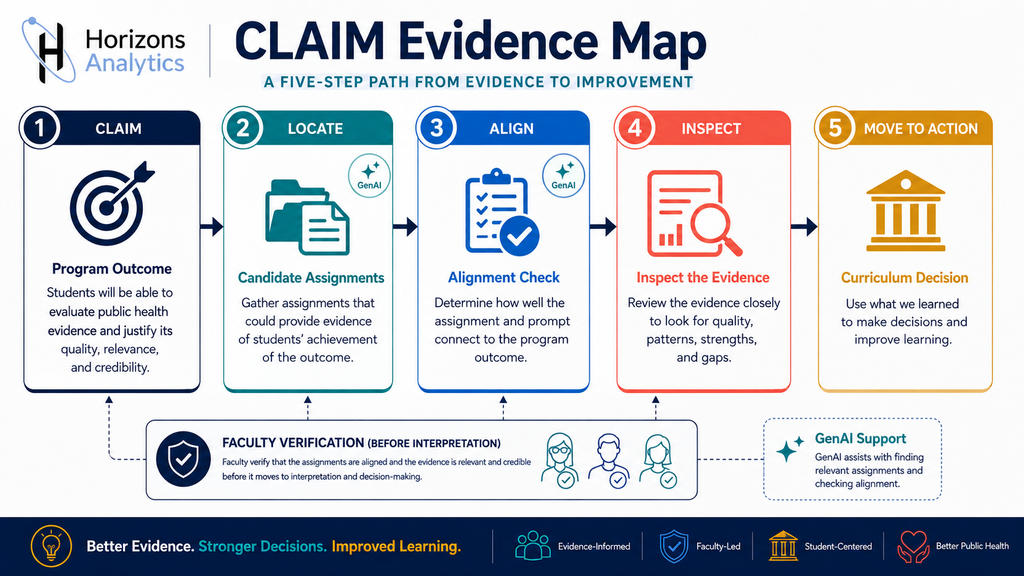
The output is simple: one learning claim, one defensible evidence source, clear limits on interpretation, and a decision the team is prepared to consider.
🤖 6. Where GenAI helps
GenAI is especially useful before faculty begin reviewing student work.
| Assessment step | Helpful GenAI role | Human responsibility |
| Scan assignments | Find tasks that appear connected to the PLO | Confirm the task actually elicits the learning |
| Compare rubrics | Identify criteria that correspond with the outcome | Judge whether the criteria capture the intended construct |
| Find duplication | Flag several assignments measuring similar performances | Decide which source is most useful |
| Prepare evidence map | Organize candidate sources and unresolved questions | Approve the evidence plan |
| Summarize faculty notes | Group recurring observations after review | Verify themes against original evidence |
A useful first-pass prompt:
You are helping a faculty team identify candidate evidence
for program learning assessment.

Program learning outcome:
[PASTE OUTCOME]

Assessment question:
[PASTE QUESTION]

Review the supplied assignment directions and rubrics.

For each candidate evidence source:

1. Identify the student performance that can be observed.
2. Explain how it relates to the program outcome.
3. Identify the exact rubric criterion or assignment requirement
   supporting the connection.
4. Identify parts of the outcome the artifact does NOT measure.
5. Flag missing information.
6. Suggest questions faculty should answer before using this evidence.

Do not decide that the artifact proves student learning.
Do not assign mastery levels.
Do not infer evidence that is not present in the documents.

Documents:
[PASTE APPROVED, NON-SENSITIVE MATERIAL]
Do not upload protected or student-identifiable information without authorization. Check every AI-generated connection against the original assignment, rubric, and outcome. AI output is not assessment evidence. AI cannot decide whether students learned.
Faculty and institutional professionals remain responsible for interpretation and action.
EDUCAUSE’s 2026 work report describes both increasing AI use across higher education and continuing concerns involving accuracy, privacy, policy, and independent judgment. That combination makes documented human review especially important in assessment work.
Use the least complicated tool that does the job well.
⚖️ 7. Evidence, equity, and student voice
Four questions keep an evidence map from becoming another collection chart.
Validity: Does the artifact actually elicit the learning named in the outcome? A multiple-choice quiz may tell you something about conceptual knowledge but little about whether students can evaluate competing evidence.
Reliability: Can faculty apply the scoring criteria with reasonable consistency? If “quality of analysis” means something different to every reviewer, the evidence becomes harder to interpret.
Fairness: Do students across online, face-to-face, transfer, accelerated, and other pathways have comparable opportunities to produce the evidence? A capstone artifact used by only one pathway may leave part of the program invisible.
Usability: Will anyone make a decision from the finding? UC Davis explicitly recommends evidence that is aligned with the assessment question and useful for decision-making, while cautioning that collecting more evidence doesn’t automatically improve assessment.
Student voice belongs here too. Ask several students to describe what the assignment required them to demonstrate and where they learned to do it. If faculty see “evaluation of evidence” but students describe the task mainly as “finding enough sources,” you’ve learned something important before scoring begins.
🗣️ 8. Turn findings into action
Bring the evidence map and a manageable sample of student work to the meeting.
Ask:
- What do we notice?
- What can this evidence support?
- What can it not support?
- What context is missing?
- What will we change or test?
- Who owns the action?
- When will we review the result?
Keep observation separate from explanation.
Observation: Students often summarize research accurately but don’t explain why one source is stronger than another.
Premature explanation: Students lack critical-thinking skills.
Better next step: Examine where source evaluation is explicitly taught, practiced, and given feedback before the capstone.
In a composite program example, faculty initially planned to collect complete capstone portfolios. The CLAIM process narrowed the review to one policy brief section and three rubric criteria. GenAI helped compare assignment documents and identify candidate evidence, but faculty rejected one suggested source because the task measured information retrieval, not evaluation. The smaller evidence set gave reviewers time to read student reasoning closely. Their discussion then centered on where students practiced evaluating conflicting evidence earlier in the program.
The gain wasn’t more data. It was a clearer connection between the claim, the evidence, and the curriculum decision.
🌍 9. Use it across campus
| Role or setting | How to apply the idea | First step |
| Faculty member | Identify which part of an assignment demonstrates a CLO | Mark the exact task and rubric criterion |
| Program chair | Connect PLOs with direct program evidence | Choose one priority outcome |
| Assessment coordinator | Reduce unnecessary evidence collection | Run CLAIM before requesting artifacts |
| Instructional designer | Check whether assignments elicit the intended thinking | Compare the outcome with task instructions |
| General education | Identify comparable evidence across disciplines | Define the learning claim before selecting artifacts |
🔭 10. What’s next and reader action
Next issue, we’ll follow the evidence into GenAI-assisted qualitative analysis of student work. The question will be practical: Can AI help faculty identify patterns across dozens of reflections, papers, or open-ended responses without turning automated themes into conclusions?
Prep action: Save one de-identified set of open-ended assessment evidence or faculty scoring comments that takes too long to review manually.
Question of the week
If someone challenged one conclusion in your latest assessment report, could you trace it back to the exact student evidence that supports it?
Try it: Complete the CLAIM Evidence Map for one program outcome.
Discuss it: Bring one assignment your program currently calls “direct evidence” and ask what specific learning it actually lets you observe.
Share it: Forward this issue to one colleague who’s trying to reduce assessment workload without weakening the evidence.
Subscribe for weekly insights at https://horizonsanalytics.com/subscribe
New every Friday at 9 AM MT
🎓 Better evidence. Better conversations. Better learning.

Dr. Alaa Alsarhan is a higher education leader and analytics expert specializing in assessment, learning outcomes, and data-informed decision-making. He is CEO & Co-Founder of Horizons Analytics, a consultancy advancing AI-powered assessment and strategic planning in education and business. Dr. Alsarhan has authored multiple publications, delivered national keynotes, and led innovative research on high-impact practices, student success, and AI in higher education. He is a founding member of the GenAI in Higher Education Assessment Community of Practice and a fellow with the NWCCU Mission Fulfillment and Sustainability program.
View All Articles