
⚡️AI Spark Weekly: Talk It Out

A familiar human moment
You know what you want to say, but the idea refuses to arrange itself into sentences. Maybe you’re preparing for a difficult conversation, choosing between two options, or trying to explain a half-formed project. Typing feels slow because your thoughts are arriving faster than your fingers can organize them. So you keep rehearsing the same fragments in your head.
By the end of this article, you’ll have a five-minute method for talking an idea through with AI without letting AI make the decision for you.
- I think more clearly when I speak than when I type.
- I sometimes know the pieces of an idea but not how they fit.
- I want help preparing, but I still want the final words to sound like me.
Two or more YES answers? This week’s experiment is for you.
🧠 The idea in plain English
Voice AI lets you speak to an AI assistant and hear a spoken response. Some current tools also let you interrupt, clarify, and continue the exchange much like a conversation. ChatGPT, Gemini, and Claude now offer voice-based interaction, though access, interfaces, and limits vary.
The useful idea isn’t simply “talk instead of type.” It is externalized thinking: moving an unfinished thought out of your head so you can hear it, examine it, and reshape it.
Think of AI as a practice wall for a tennis player. The wall sends the ball back, but it doesn’t decide where you should play your next match.
Use voice AI to reveal your thinking, not to surrender it.
🧭 A practical prompting method
A voice conversation works better when you tell the assistant what role it should play. Do you need questions, organization, alternatives, or rehearsal? Say that before giving your story.
Three habits help:
- Name the situation. Give enough background to make the response relevant.
- Request one kind of help. Ask for questions, a summary, or options instead of “What should I do?”
- Pause and correct. Interrupt when the assistant misunderstands you.
- End with a recap. Ask it to separate your ideas from its suggestions.
| Mistake | Why it hurts | Quick fix |
|---|---|---|
| Speaking without a goal | The conversation wanders | State what you want at the beginning |
| Asking AI to decide | It lacks your full values and context | Ask for questions and trade-offs |
| Accepting its summary unchanged | It may flatten or misread your meaning | Correct it and request a revised recap |
Try the TALK Back Framework:
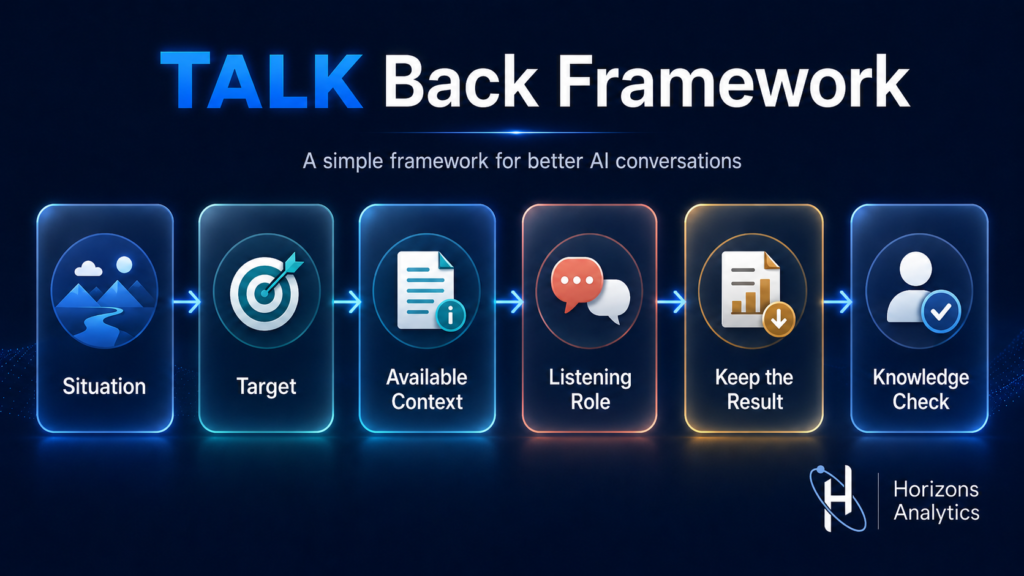
Situation: I am thinking through [situation]. Target: By the end, I want to [goal]. Available context: The important facts are [context]. Listening role: Ask me [number] questions, one at a time, to help me clarify my thinking.
Keep the result: Finish with [bullet summary, outline, rehearsal notes, or options table]. Knowledge check: Separate what I told you from what you inferred, then ask what you may have misunderstood.
Personal life
I’m choosing between two weekend plans. Ask me four questions about cost, energy, family needs, and what would make the weekend feel worthwhile. Then summarize my priorities without choosing for me.
Work or volunteering
I need to explain a delayed community project to volunteers. Let me describe what happened. Then help me organize a three-minute update that is honest, calm, and clear about the next step.
Learning
I’m studying a topic I partly understand. Ask me to explain it aloud, identify gaps in my explanation, and give me two questions that test whether I truly understand it.
Practice level: Beginner
🌍 Try it across daily life
| Life area | Real situation | Prompt to try | Human payoff |
| Personal life | Comparing two commitments | Ask me questions about time, cost, energy, and priorities; don’t choose for me | A clearer decision based on your priorities |
| Work or volunteering | Preparing an update | Listen to my rough explanation, then organize it into context, issue, and next step | A usable message with less rambling |
| Learning | Checking understanding | Ask me to teach the idea aloud, then point out missing steps | Better understanding and focused study |
| Family or community | Preparing for a sensitive discussion | Help me rehearse a respectful opening and identify questions I should ask | A calmer, more constructive conversation |
⏱️ The five-minute experiment
Your goal:
Turn one scattered thought into a clear summary and next action.
What to give AI:
A real issue that is safe to discuss and does not contain private or confidential information.
Copy this prompt:
I want to think out loud for two minutes about something I'm working through. Don't solve it immediately.

First, listen and then summarize what you heard in three parts:
1. What seems clear
2. What still seems uncertain
3. What decision or next action I may be facing

Then ask me one question that would help me think more clearly. Separate my statements from your interpretation.
What to notice:
- Did speaking reveal something you hadn’t written down?
- Did the summary accurately reflect your priorities?
- Which part needed correction or more context?
🚶 Grow the skill
| Starting move | Stronger move | Why it helps |
| Ask for advice immediately | Ask for clarifying questions first | The response uses more of your real context |
| Speak in one long stream | Pause after each main idea | You can correct misunderstandings early |
| Accept the recap | Mark what is accurate, missing, or inferred | Your final notes stay faithful to your thinking |
| Let AI write your conclusion | State the conclusion yourself and ask for critique | You keep ownership of the decision |
Confidence grows through small experiments, not technical perfection.
🤝 Keep it human
Before an important conversation, voice AI can help you rehearse an opening, identify assumptions, or prepare two respectful questions. Afterward, it can help you organize your private notes and identify an action you promised to take.
But don’t outsource empathy. AI didn’t see the other person’s expression, hear every pause, or experience the relationship’s history.
Try the method with a colleague, friend, or family member using a harmless topic. Compare the summaries each of you receives. The differences will show how strongly context and wording affect the result.

🕵️ Myth and judgment check
Myth: A natural-sounding AI conversation understands me the way another person does.
Reality: A fluent voice can feel attentive, but fluency isn’t lived experience, emotional understanding, or complete knowledge of your situation. The assistant responds to the information available in the conversation. A warm tone can make an incomplete answer feel more reliable than it is.
In real life: Weak use asks, “Should I confront my friend?” Thoughtful use asks for questions that clarify what happened, what outcome matters, and what assumptions need checking.
A convincing voice is still an AI output that requires your judgment.
| Check | Ask yourself |
| Accuracy | Did the recap reflect what I actually said? |
| Privacy | Am I sharing details that belong to someone else? |
| Missing context or bias | What history, culture, emotion, or constraint is absent? |
| Human responsibility | Which choice, message, or action must remain mine? |
Don’t upload confidential, private, student-identifiable, medical, financial, or workplace-sensitive information unless you’re authorized to do so.
📖 A small story of change
A parent returning to school couldn’t decide whether to take two classes while working full time. Their first voice prompt was simply, “What should I do?” and the response gave generic time-management advice. They tried again, explaining their weekly schedule and asking the assistant to question them about energy, childcare, finances, and graduation timing. The conversation revealed that the main concern wasn’t workload; it was losing the one evening reserved for family. The assistant organized the trade-offs, and the parent used that summary to speak with an adviser before deciding.
The useful result wasn’t an AI decision. It was a better human conversation.
🔮 What’s next and reader invitation
Next week, we’ll build on this practice by exploring how to ask AI better follow-up questions. A first response is rarely the end of useful prompting.
During the week, save one AI answer that feels incomplete. Mark the sentence where you wished the assistant had asked you a question instead.
Question of the week: When does speaking an idea aloud help you notice something that writing does not?
Try it: Complete the five-minute voice experiment with one safe, real situation.
Share it: Compare your summary with one other person’s and discuss what each of you corrected.
Join the community:
Subscribe for weekly tips at https://horizonsanalytics.com/subscribe
New every Monday at 9 AM MT
⚡️Stay curious, stay sparky!

Dr. Alaa Alsarhan is a higher education leader and analytics expert specializing in assessment, learning outcomes, and data-informed decision-making. He is CEO & Co-Founder of Horizons Analytics, a consultancy advancing AI-powered assessment and strategic planning in education and business. Dr. Alsarhan has authored multiple publications, delivered national keynotes, and led innovative research on high-impact practices, student success, and AI in higher education. He is a founding member of the GenAI in Higher Education Assessment Community of Practice and a fellow with the NWCCU Mission Fulfillment and Sustainability program.
View All Articles