🔍 Evaluating What Matters: Program Evaluation Frameworks That Actually Guide Improvement

From logic models to participatory evaluation, turning assessment into action
Introduction
Program evaluation is where assessment meets strategy. It’s not just about proving success—it’s about improving it. Yet, in many higher ed settings, evaluation becomes a compliance exercise: reports are written, boxes checked, and shelves filled. This week’s blog takes a practical approach to program evaluation frameworks that help faculty, staff, and administrators connect evidence to meaningful change. From logic models to participatory and developmental approaches, you’ll learn how to pick the right framework for your goals—and how to make evaluation a tool for growth, not just accountability.
💡 Best Practices & Tips: Evaluation “When Done Well”
| Step | What to Do | Why It Matters |
|---|---|---|
| 1️⃣ Start with a Logic Model 🧩 | Map inputs → activities → outputs → outcomes → impact. Keep it visual and shared. | Clarifies assumptions and makes improvement measurable. |
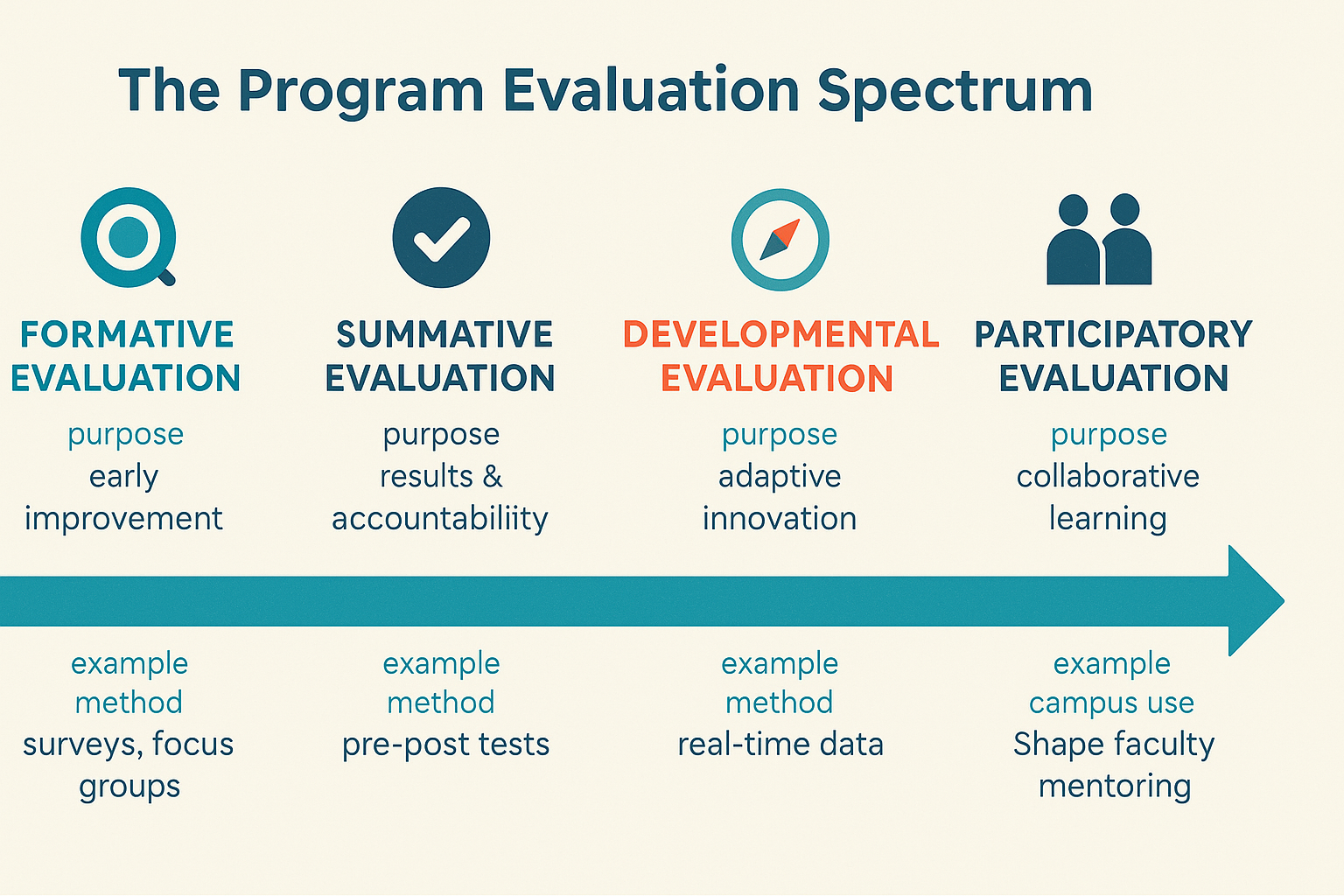
| 2️⃣ Choose the Right Evaluation Type 🔍 | – Summative: what worked? – Formative: what’s working right now? – Developmental: what’s emerging or changing? – Participatory: who owns the data? | Different questions require different lenses. |
| 3️⃣ Involve Stakeholders Early 🤝 | Include students, faculty, staff, and even community partners in design, data interpretation, and recommendations. | Builds trust and produces richer, more actionable findings. |
| 4️⃣ Align Data with Decisions 📊 | Only collect what informs real choices: resources, staffing, curriculum, policy. | Data should feed the next decision, not the next binder. |
| 5️⃣ Use AI & LLMs Strategically 🤖 | Use LLMs to summarize qualitative data, categorize themes, or draft logic model narratives. Always validate AI outputs with human review. | Saves time, enhances synthesis, and supports transparency. |
💡 Quick Tip: Every evaluation should answer the question: “So what?” If your findings can’t inform a resource allocation, training, or redesign, refine your purpose before collecting more data.
🏫 Example / Case Illustration
Case: Evaluating a Faculty Mentorship Program Using a Developmental Lens
A mid-sized teaching university launched a new faculty mentorship initiative to improve first-year faculty retention and engagement. Initially, leadership requested a summative report after year one—standard surveys, participation counts, satisfaction rates. But when the institutional research (IR) team met with the mentors and mentees, they realized the program was still evolving. A developmental evaluation approach would yield better insights.
1. Clarifying the Model:
The IR director facilitated a short workshop where participants co-created a logic model on a shared whiteboard:
- Inputs: mentor time, professional development funds, coordinator support.
- Activities: monthly mentoring sessions, peer-observation circles, and reflection journals.
- Outputs: participation logs, reflection entries, and training attendance.
- Outcomes: improved teaching confidence, reduced burnout, stronger belonging.
2. Iterative Data Collection:
Instead of waiting until the end, the team collected monthly reflective prompts from both mentors and mentees. Using an LLM trained on prior institutional data, they coded open-ended responses for themes like “growth mindset,” “isolation,” and “confidence.” Faculty confirmed and refined these categories during reflection circles.
3. Action & Adaptation:
By midyear, the data showed that mentees who attended at least four sessions demonstrated a 25% increase in teaching self-efficacy (survey-based). However, mentors expressed burnout from documentation requirements. The program adjusted midstream—reducing paperwork and adding optional group mentoring.
4. Impact & Learning:
By the end of year two, the program reported:
- 87% mentor retention (up from 62%).
- Statistically significant gains in self-efficacy and belonging (p < .05).
- Qualitative feedback indicating better cross-department collaboration.
Rather than a one-time report, the evaluation became an ongoing conversation. Leadership used the logic model to secure new funding for expanded mentorship clusters.
Key takeaway: Developmental and participatory frameworks make evaluation adaptive, timely, and empowering. They turn “assessment fatigue” into shared ownership.
🧭 Closing
Program evaluation isn’t about proving perfection—it’s about learning together. When done well, evaluation frameworks create shared understanding, align strategic priorities, and illuminate impact over time. Whether you use a logic model for clarity, a developmental lens for innovation, or a participatory model for inclusion, the best framework is the one that builds agency across your campus.
The real shift comes when evaluation stops being an “external audit” and becomes a shared design space—a place where faculty, staff, and students learn how their work connects to institutional goals and student success.
👉 Next week: We’ll kick off a new cycle with High-Impact Practices (HIPs)—diving into how predictive analytics and LLMs can uncover the true impact of HIP quality on student outcomes.
❓ Question of the Week
Which evaluation framework—formative, summative, developmental, or participatory—best fits your current project, and what would you need to adapt it for deeper learning?

Dr. Alaa Alsarhan is a higher education leader and analytics expert specializing in assessment, learning outcomes, and data-informed decision-making. He is CEO & Co-Founder of Horizons Analytics, a consultancy advancing AI-powered assessment and strategic planning in education and business. Dr. Alsarhan has authored multiple publications, delivered national keynotes, and led innovative research on high-impact practices, student success, and AI in higher education. He is a founding member of the GenAI in Higher Education Assessment Community of Practice and a fellow with the NWCCU Mission Fulfillment and Sustainability program.
View All Articles