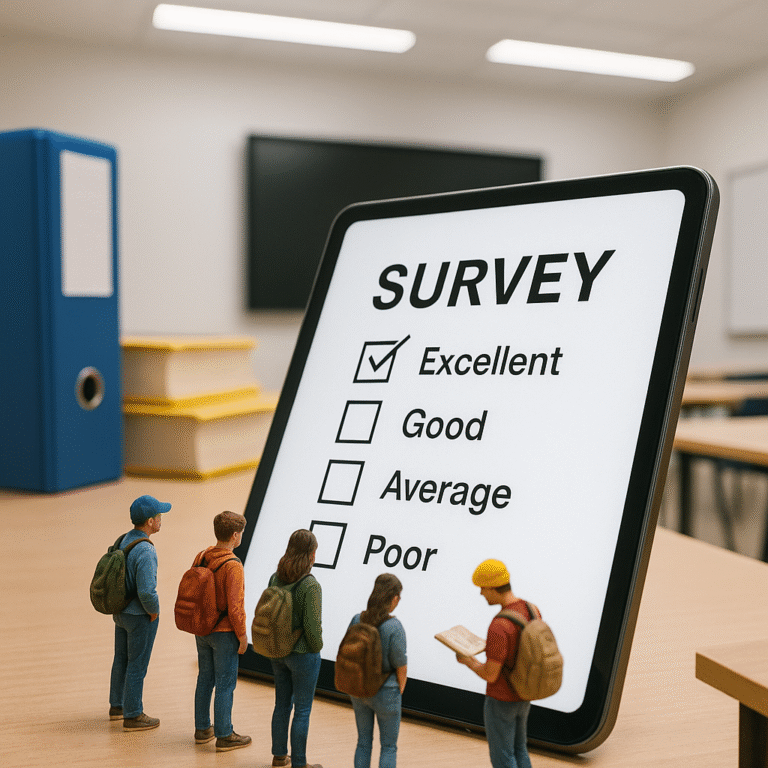
📝 Smarter Surveys, Better Insights: Designing Instruments That Actually Work

From vague questions to valid, reliable data
Introduction
If you’ve ever read a survey and thought, “What are they even asking me?”—you’re not alone. Poorly designed surveys waste time, frustrate respondents, and lead to meaningless data. In higher education, where surveys influence program reviews, accreditation, and student success initiatives, we can’t afford vague or biased instruments. This week’s blog unpacks the anatomy of a high-quality survey—from purpose to pilot testing—and shows how AI can help refine items for clarity, alignment, and insight.
Best Practices & Tips: Designing Quality Surveys
- 🎯 Start with the purpose (always): A good survey begins with a clear research question or evaluation purpose. “What do we want to know?” guides everything else.
- 📚 Review the literature: Before reinventing the wheel, check existing validated surveys. Borrow wisely, adapt cautiously.
- 🖊️ Craft clear, unbiased items: Avoid double-barreled questions (“How satisfied are you with advising and financial aid?”). Stick to one construct at a time.
- ⚖️ Ensure reliability & validity: Reliability ensures consistency; validity ensures accuracy. Techniques like Cronbach’s alpha and factor analysis help check quality.
- 🤖 Use LLMs as co-pilots: AI can flag ambiguous wording, suggest response scales, and even simulate how different populations might interpret an item.
- 🔍 Pilot before launch: A small test run with feedback saves headaches later. Look for skipped questions, confusion, or misaligned scales.
Case Illustration: Redesigning a Student Satisfaction Survey
The problem:
A midwestern university had a 60-question “Student Satisfaction Survey” with declining response rates (down to 18%). Faculty grumbled about vague results. Administrators admitted they couldn’t link survey data to actionable improvements.
Step 1 – Clarify Purpose:
A cross-unit committee asked: What do we actually need to know? They prioritized three areas: advising quality, classroom climate, and student support services.
Step 2 – Review & Adapt:
The team examined NACADA advising instruments and AAC&U climate surveys. They adapted validated questions rather than writing entirely new ones.
Step 3 – Item Rewrite with AI:
An LLM reviewed draft items and flagged issues:
- Original: “Are you satisfied with advising?”
- Revised: “How often did your advisor provide feedback that helped you make academic decisions?”
This shifted the focus from vague satisfaction to measurable behavior.
Step 4 – Pilot Test:
100 students piloted the new survey. Response rates improved (37%) and students reported the questions were “clearer and more relevant.”
Step 5 – Analyze & Act:
Reliability checks confirmed strong consistency across scales (Cronbach’s alpha > .80). Findings revealed students valued frequent, personalized advising contact, leading to targeted faculty development workshops.
The outcome: Response rates climbed above 50% in subsequent years, and results fed directly into program review and retention strategies.
Closing Thoughts
Surveys are deceptively simple. On the surface, they’re just questions and checkboxes. But beneath the surface, they’re powerful tools for understanding experiences, shaping policy, and driving change—if designed well. Clarity of purpose, alignment with literature, strong wording, and rigorous testing separate “meh” surveys from transformative ones. And in today’s AI era, we have extra tools to refine, simulate, and validate before going live.
Next week, we’ll move from surveys to program evaluation frameworks—logic models, participatory evaluation, and how to design approaches that serve both accountability and learning.
❓ Question of the Week
Think about the last survey you sent (or took). Was the purpose crystal clear from the questions asked? If not, what would you rewrite to sharpen its focus?

Dr. Alaa Alsarhan is a higher education leader and analytics expert specializing in assessment, learning outcomes, and data-informed decision-making. He is CEO & Co-Founder of Horizons Analytics, a consultancy advancing AI-powered assessment and strategic planning in education and business. Dr. Alsarhan has authored multiple publications, delivered national keynotes, and led innovative research on high-impact practices, student success, and AI in higher education. He is a founding member of the GenAI in Higher Education Assessment Community of Practice and a fellow with the NWCCU Mission Fulfillment and Sustainability program.
View All Articles