
Mentoring That Moves the Needle: How Evaluation Frameworks Strengthen Student Success

Using logic models, developmental evaluation, and AI‑supported insight to elevate mentoring programs
🌅 Introduction
Mentoring programs are some of the most quietly powerful engines on any campus. When they’re built well, they boost belonging, sharpen academic confidence, and anchor students through the wobbliest semesters. When they’re not? They become coffee‑and‑chat clubs with no measurable impact. Today’s post unpacks how to design, evaluate, and continuously improve mentoring initiatives using logic models, participatory approaches, and (yes) a little AI assistance. Whether your institution is launching a new mentoring effort or refining one that’s been around since dial‑up internet, this guide offers a practical, evidence‑informed path forward.
⭐ Best Practices & Tips: Evaluating & Strengthening Mentoring Programs
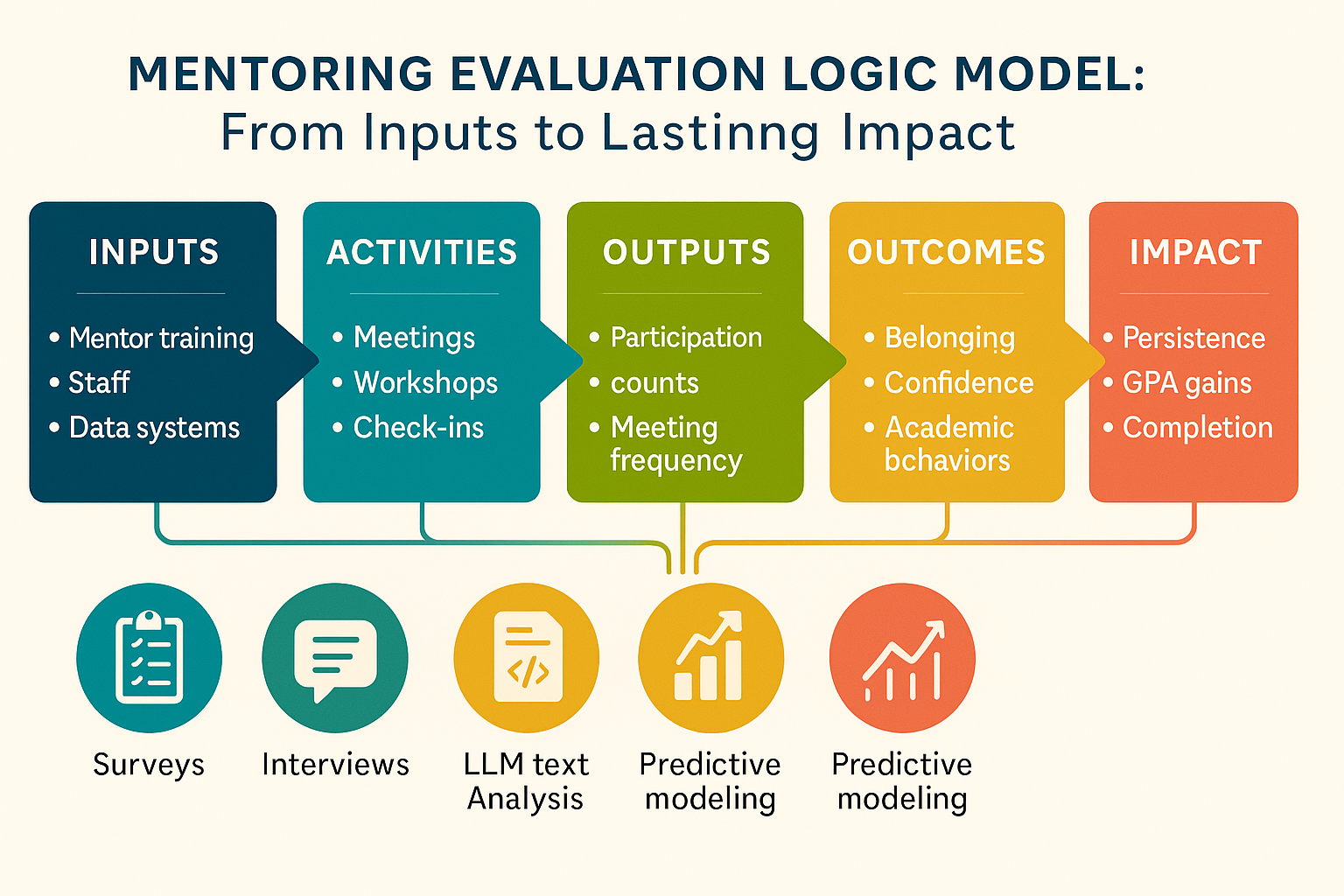
1️⃣ Start With a Logic Model (Your Roadmap to Impact)
A clear logic model keeps mentoring aligned with outcomes—not vibes.
- Inputs: mentor training, staffing, data systems
- Activities: meetings, skill‑building sessions, check‑ins
- Outputs: session frequency, participation rates
- Outcomes: belonging, persistence, academic readiness
This structure clarifies what success should look like long before you run the first analysis.
2️⃣ Use Developmental Evaluation for Programs Still Evolving
Perfect for mentoring models adapting to student needs.
- Supports rapid improvement rather than static judgment
- Captures real‑time feedback through interviews, notes, and short surveys
- Encourages iteration: refine → test → refine again
3️⃣ Prioritize Mentor Training With Observable Behaviors
Training only counts if it changes what mentors actually do.
- Teach micro‑skills: reflective questioning, goal scaffolding, warm referrals
- Use rubrics for mentor practices
- Apply LLMs to review anonymized meeting notes for theme detection and consistency
4️⃣ Embed Equity Into Every Evaluation Step
Mentoring can widen gaps if evaluation is blind to context.
- Compare outcomes across first‑gen, Pell‑eligible, transfer, and underrepresented groups
- Use intersectional lenses rather than single‑group comparisons
- Validate that mentoring practices are culturally sustaining
5️⃣ Tell the Story With Mixed Methods
Numbers show patterns. Words reveal meaning.
- Use predictive models to identify which mentoring activities correlate with persistence
- Pair them with qualitative insights from mentees and mentors
- Let the story synthesize—not compete—across methods
🧩 Case Illustration: Rebuilding a Peer Mentoring Program With Evidence
A mid‑western university noticed their long‑running peer mentoring program wasn’t producing the same gains it once did. Participation was steady, but retention and GPA differences between participants and non‑participants had flattened. Leadership wanted to know: Is the program still working, and if not, why?
Step 1: Logic Model Refresh
The team updated the model to reflect modern student needs:
- Short‑term: stronger academic routines, help‑seeking confidence
- Mid‑term: increased belonging, clarity of goals
- Long‑term: persistence and on‑time completion
This clarified what data needed to be collected—and what to stop tracking.
Step 2: Developmental Evaluation (DE) Cycle
Mentors and students provided rapid‑feedback insights every two weeks. Themes emerged: many sessions drifted into social territory without clear academic or skills‑based focus.
Step 3: LLM‑Supported Note Analysis
Anonymized mentoring notes were processed using an LLM to detect patterns in conversation topics.
The findings were telling:
- 58% of sessions centered on “general encouragement”
- Only 22% involved explicit academic planning
- Underrepresented students were more likely to receive motivational talk and less likely to receive structured study planning
This wasn’t malice—just drift.
Step 4: Training Overhaul
Mentor training shifted from “be supportive” to:
- Guided goal‑setting templates
- Step‑by‑step academic planning prompts
- Cultural humility strategies
- Micro‑coaching models
Step 5: Outcome Evaluation
After one year:
- Mentees in the revised model persisted at a rate 6.4 points higher than non‑participants
- Belonging scores increased by 18%
- Mentors reported clearer expectations and higher confidence
The biggest win? Students described feeling “seen and guided”—not just encouraged.
🌻 Closing
Strong mentoring doesn’t happen by accident—it emerges from intentional design, ongoing evaluation, and a commitment to serving students as whole humans. Logic models bring clarity, developmental evaluation brings adaptability, predictive analytics uncover signals, and LLMs help make sense of the narrative threads. Together, they form a powerful ecosystem of support that grows with your students rather than lagging behind them.
Next Friday, we’ll dive into High‑Impact Practices, exploring what “done well” really means, how to measure quality, and how predictive analytics can reveal which HIPs are truly moving outcomes on your campus.
💬 Question of the Week
What part of your mentoring program—training, structure, or evaluation—would create the biggest improvement if redesigned today?

Dr. Alaa Alsarhan is a higher education leader and analytics expert specializing in assessment, learning outcomes, and data-informed decision-making. He is CEO & Co-Founder of Horizons Analytics, a consultancy advancing AI-powered assessment and strategic planning in education and business. Dr. Alsarhan has authored multiple publications, delivered national keynotes, and led innovative research on high-impact practices, student success, and AI in higher education. He is a founding member of the GenAI in Higher Education Assessment Community of Practice and a fellow with the NWCCU Mission Fulfillment and Sustainability program.
View All Articles