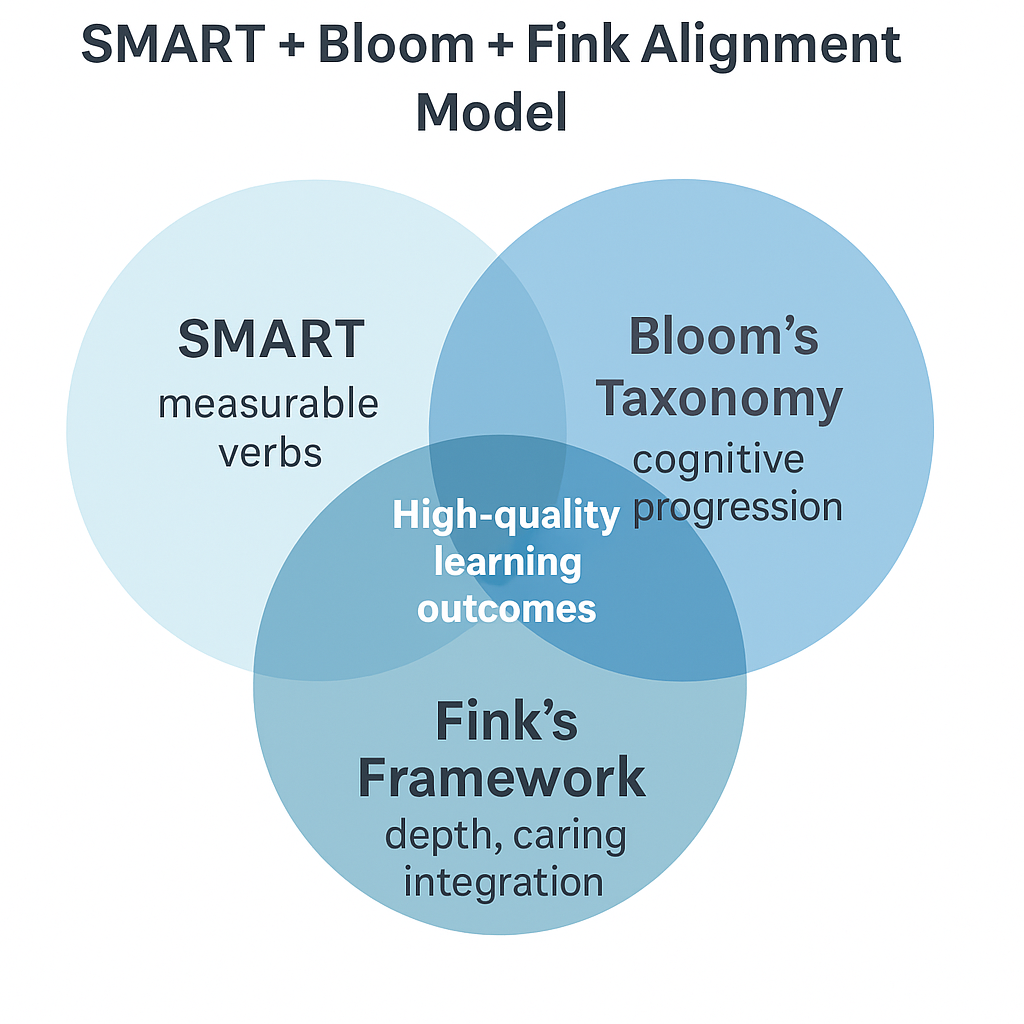
🤖 Making Learning Outcomes SMART with AI

Writing Program and Course Learning Outcomes (PLOs & CLOs) is a bit like writing New Year’s resolutions—everyone starts with good intentions, but half end up vague, unmeasurable, and quietly forgotten. The good news? Today’s AI tools can help us sharpen those outcomes into clear, measurable, and aligned statements that actually guide teaching and assessment. Let’s explore how to move from fuzzy goals to SMART outcomes that stick.
💡 Best Practices & Tips
1) Keep outcomes SMART 📏
- Specific: Narrow the scope—no “students will understand everything.”
- Measurable: Attach observable verbs like analyze, evaluate, create.
- Achievable: Stretch, but don’t break—students aren’t becoming Nobel laureates in Intro Chem.
- Relevant: Connect directly to program or course objectives.
- Time-bound: Outcomes should be assessed within a course or program cycle.
| Weak Outcome ❌ | SMART Outcome ✅ |
|---|---|
| Students will understand ethics in business. | Students will evaluate ethical dilemmas using at least two established frameworks (e.g., utilitarianism, deontology). |
| Students will know lab safety. | Students will demonstrate correct safety procedures in 4 of 5 simulated lab scenarios. |
2) Align outcomes with Bloom’s or Fink’s 🌱
- Use Bloom’s Taxonomy for a progression of cognitive skills: remember → understand → apply → analyze → evaluate → create.
- Try Fink’s Taxonomy to add depth: integration, human dimension, caring, learning how to learn.
- Pro tip: Blend both! For example, “apply statistical methods” (Bloom) while “reflecting on their ethical use in real-world decisions” (Fink).
3) Let AI be your drafting buddy 🤖
- Use AI to generate first drafts of outcomes from your syllabus or course description.
- Ask AI to suggest Bloom-aligned verbs or reframe vague outcomes into measurable ones.
- Caution: Treat AI like a helpful grad assistant, not a final arbiter—always review for accuracy and fit.
4) Map CLOs to PLOs 📊
- Create a matrix: courses on one axis, PLOs on the other.
- Check coverage: Are some PLOs over-assessed and others ignored?
- Quick win: Ensure intro courses build foundational skills, while advanced courses assess higher-order outcomes.
5) Build in evidence loops 🔄
- Tie each CLO to at least one assessment method (exam question, rubric criterion, project).
- Document which evidence gets collected and how often.
- Avoid the trap of “assess everything, everywhere, all at once.” Instead, assess meaningfully and use results to adjust curriculum.
🏫 Real-Life Example
At a large urban university, the School of Nursing struggled with CLOs like “Students will understand patient-centered care.” Faculty felt it was unmeasurable.
The pivot: They piloted AI tools to reframe outcomes. Within two workshops, the faculty revised outcomes to:
- “Students will demonstrate patient-centered communication using role-play simulations.”
- “Students will analyze patient case studies to identify culturally responsive care strategies.”
Assessment alignment:
- Communication was measured through rubric-based simulation evaluations.
- Case study analysis was scored on clarity, depth, and relevance to diverse populations.
Impact: Faculty reported clearer grading, students valued feedback, and the program accreditation reviewers applauded the stronger alignment between CLOs, PLOs, and assessment methods.
🧭 Takeaway & What’s Next
Clear, aligned learning outcomes are the compass for both teaching and assessment. SMART framing makes them measurable, Bloom ensures cognitive rigor, Fink adds transformative depth, and AI accelerates the drafting process. When we invest in well-written outcomes, we make life easier for students, faculty, and accreditors alike.
Next week: 📈 Customized Strategies for Student Success & Retention—how data analytics, mentoring, and curriculum tweaks can keep students engaged and on track.
❓ Question of the Week
Which of your current learning outcomes could benefit most from a SMART + Bloom + Fink makeover—and how might AI help in the rewrite?

Dr. Alaa Alsarhan is a higher education leader and analytics expert specializing in assessment, learning outcomes, and data-informed decision-making. He is CEO & Co-Founder of Horizons Analytics, a consultancy advancing AI-powered assessment and strategic planning in education and business. Dr. Alsarhan has authored multiple publications, delivered national keynotes, and led innovative research on high-impact practices, student success, and AI in higher education. He is a founding member of the GenAI in Higher Education Assessment Community of Practice and a fellow with the NWCCU Mission Fulfillment and Sustainability program.
View All Articles