🎓Designing HIPs That Actually Work: From “Cool Idea” to Student Transformation

Turning High-Impact Practices from buzzwords into measurable, life-changing learning experiences
🌅 Introduction
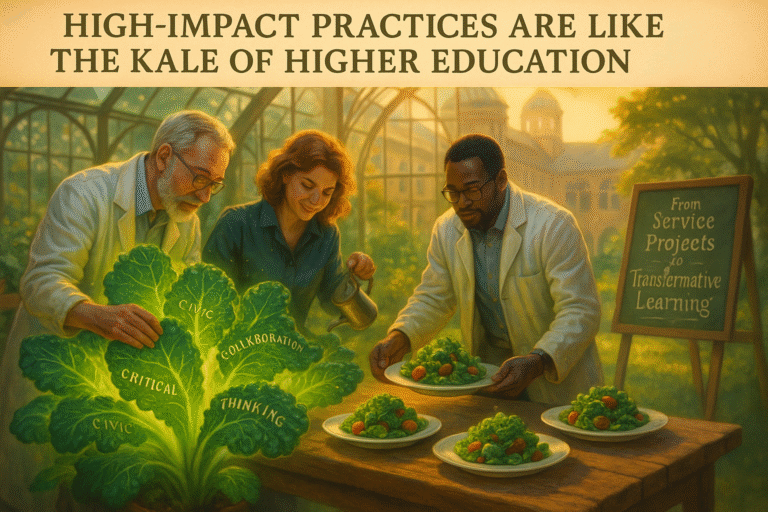
High-Impact Practices (HIPs) are like the kale of higher ed — everyone says they’re good for you, but few know how to make them taste great. Faculty and staff love the idea of transformative learning experiences, but many struggle with the “how.” This week’s blog focuses on designing HIPs that actually deliver on their promise of deeper learning, equity, and engagement — and how to assess that impact using both classical and cutting-edge (LLM-enhanced!) methods.
Let’s move beyond “we did a service project” and into “we cultivated measurable growth in civic identity, collaboration, and critical thinking.”
🌟 Best Practices & Tips: Designing HIPs “When Done Well”
| HIP Element | “When Done Well” Means… | Practical Tips |
|---|---|---|
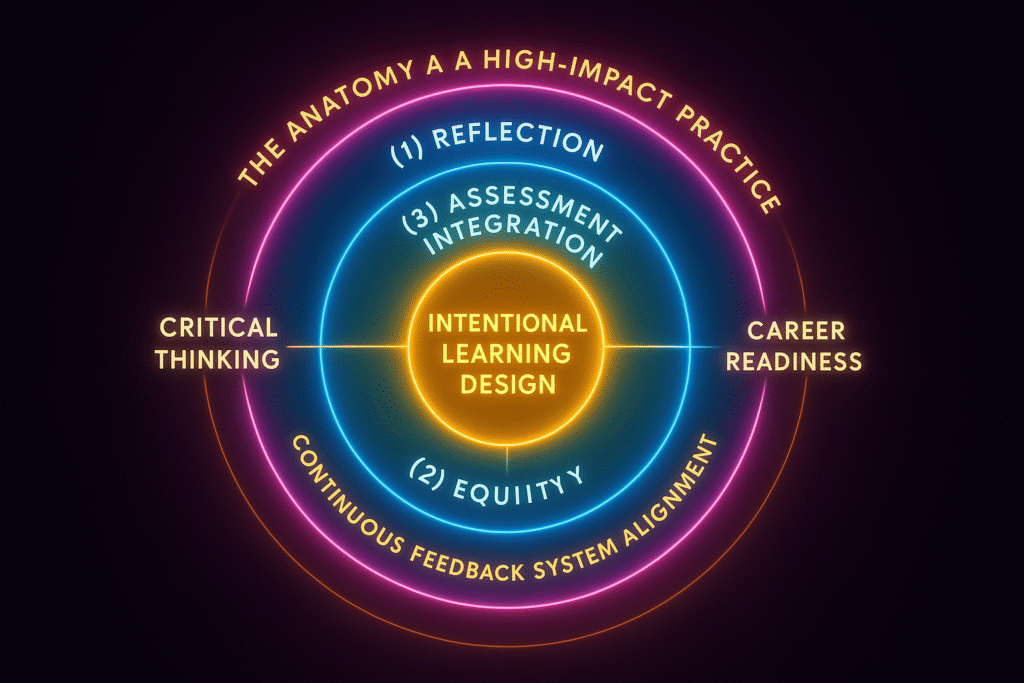
| Intentional Design | Outcomes align with program goals, not just activities. | ✅ Map HIP objectives to PLOs/CLOs. ✅ Use Fink’s Significant Learning taxonomy to identify lasting impact areas. |
| Equity & Access | Every student has meaningful participation. | 👥 Audit participation data for gaps. 🏗️ Use predictive modeling to identify students less likely to opt in and design supports. |
| Reflection | Students synthesize learning through structured reflection. | ✍️ Require short reflective prompts at midpoint and end. 💡 Use LLM tools (e.g., ChatGPT-based rubrics) to analyze reflection quality for depth and growth. |
| Assessment Integration | Evaluation measures both learning and process quality. | 📊 Use rubrics tied to outcomes, not completion. 🤖 Deploy LLMs to evaluate rubric coherence and bias. |
| Feedback Loops | Faculty learn from results to refine design. | 🔄 Create an annual HIP reflection brief—what worked, what didn’t, what to scale. |
Pro Tip: Treat HIPs as living systems, not standalone experiences. Use systems thinking to identify ripple effects across courses, advising, and co-curricular spaces.
🧩 Case Illustration: “The Civic Engagement Capstone That Changed Everything”
At a mid-sized teaching university a senior-level Civic Engagement Capstone was designed to be more than a box-checking exercise. The program team began by mapping PLOs to the AAC&U VALUE rubrics and integrating three layers of intentionality:
- Cognitive Growth (Learning to Learn): Students identified a civic issue, analyzed it using data, and proposed solutions. The CLOs targeted critical thinking and information literacy.
- Personal Growth (Learning to Be): Through structured reflection journals, students evaluated their assumptions, biases, and sense of agency.
- Community Growth (Learning to Do): Partnering with local non-profits, students implemented micro-projects that yielded measurable outcomes (e.g., improved access to local food resources).
To evaluate effectiveness, the assessment office used a propensity score matching (PSM) approach to compare capstone students with non-participants. Results showed a 22% higher retention in graduate programs and a 15% increase in civic-mindedness survey scores.
Next, the team used an LLM-assisted rubric audit: ChatGPT analyzed reflection responses for alignment with Fink’s “Human Dimension” domain. The AI flagged reflections where students described “participation” but not “personal transformation,” leading faculty to add a midterm reflective checkpoint the following semester.
This small adjustment produced a noticeable increase in qualitative depth (students moved from “we volunteered” to “I realized how my privilege shapes community impact”).
🌻 Closing Thoughts
When HIPs are designed with purpose, access, and reflection in mind, they move from “extra credit experiences” to engines of equity and transformation. The secret isn’t just more HIPs — it’s better HIPs: aligned, evaluated, and continually improved.
Next week, we’ll dive into Evaluating Learning Outcomes (PLOs & CLOs) Using Fink’s Framework and LLMs — including how to spot weak verbs, fuzzy outcomes, and misaligned assessments using AI tools.
💬 Question of the Week
What’s one HIP you’re involved in (or considering) — and how might you redesign it to make its outcomes more intentional, inclusive, and measurable?

Dr. Alaa Alsarhan is a higher education leader and analytics expert specializing in assessment, learning outcomes, and data-informed decision-making. He is CEO & Co-Founder of Horizons Analytics, a consultancy advancing AI-powered assessment and strategic planning in education and business. Dr. Alsarhan has authored multiple publications, delivered national keynotes, and led innovative research on high-impact practices, student success, and AI in higher education. He is a founding member of the GenAI in Higher Education Assessment Community of Practice and a fellow with the NWCCU Mission Fulfillment and Sustainability program.
View All Articles