High-Impact Practices: Fresh Pathways for Global, Research, and Service Learning

Friday, September 19, 2025
👋 Introduction
High-Impact Practices (HIPs) are the triple-shot espresso of higher education—powerful jolts that fuel learning, engagement, and retention. But they only live up to the hype when they’re thoughtfully designed and broadly accessible. This week, we’re kicking off a new cycle by exploring innovative ways to weave global experiences, undergraduate research, and service-learning into programs that energize students and faculty.
💡 Best Practices & Tips
1️⃣ Redefine “global” without passports ✈️
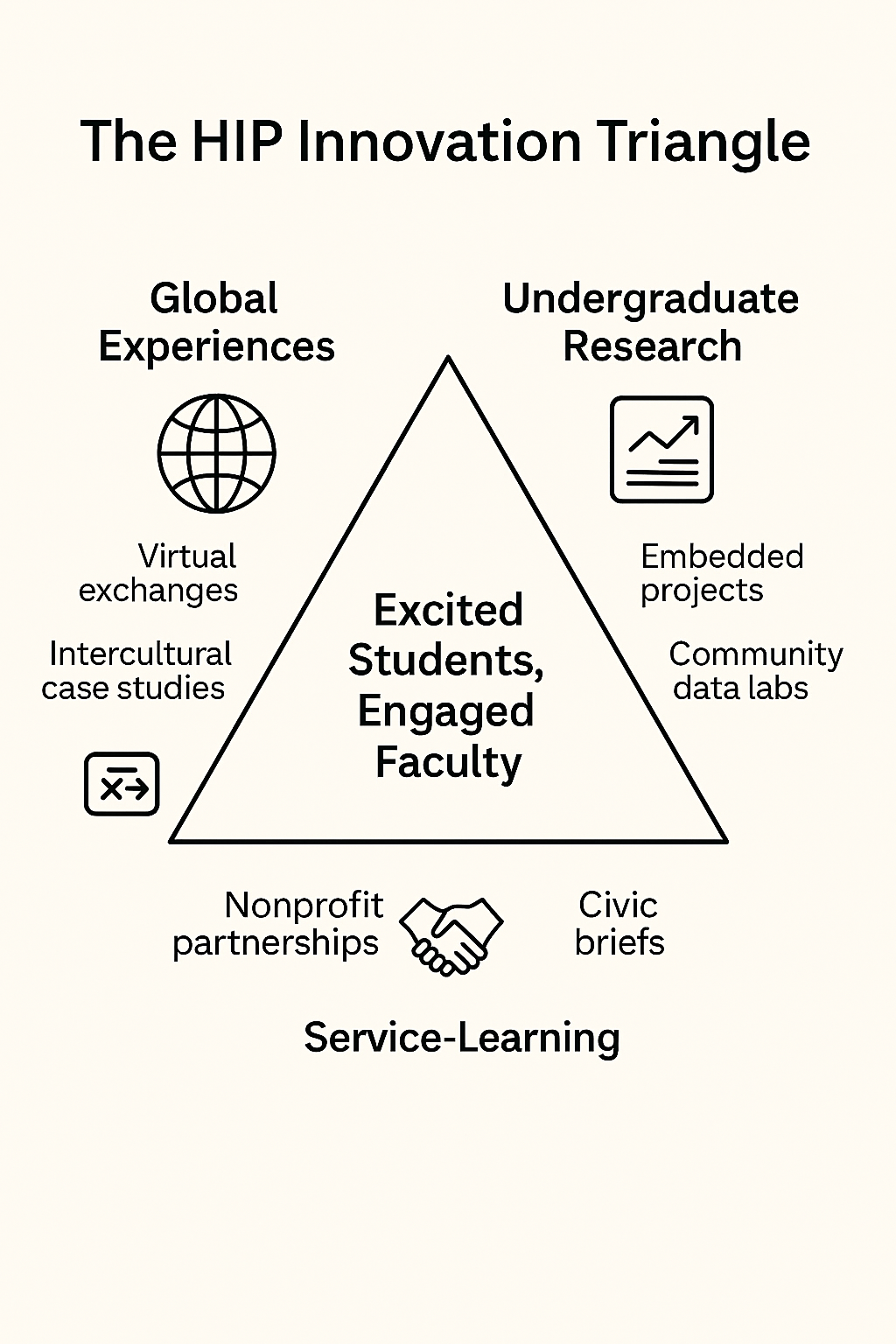
- Strategy: Bring the world into the classroom through virtual exchange partnerships or globally focused case studies.
- Mistake to avoid: Assuming global = expensive study abroad.
- Quick win: Pair a sociology class with an international partner university for one collaborative project.
2️⃣ Democratize undergraduate research 🔬
- Strategy: Embed research modules in intro-level courses (literature reviews, small datasets).
- Mistake to avoid: Reserving research for honors students only.
- Quick win: Ask every first-year student to conduct a micro-project tied to local community issues.
3️⃣ Service-learning with real stakes 🌱
- Strategy: Partner with nonprofits or civic groups for projects that matter to both students and communities.
- Mistake to avoid: “One-day volunteerism” that doesn’t connect to course learning outcomes.
- Quick win: Replace a generic class presentation with a community-based project brief delivered to a partner.
4️⃣ Faculty incentives = faculty buy-in 💡
- Strategy: Provide recognition in tenure/promotion policies for HIP integration.
- Mistake to avoid: Assuming faculty will embrace HIPs without workload or recognition adjustments.
- Quick win: Offer course redesign stipends or “HIP Champion” teaching awards.
5️⃣ Assess HIP quality, not just participation 📊
- Strategy: Use rubrics (AAC&U VALUE rubrics for civic engagement, integrative learning). Statistical methods: Propensity Score Matching to measure impact of HIPs participation on students outcomes.
- Mistake to avoid: Reporting numbers only (e.g., “200 students studied abroad”).
- Quick win: Collect reflective essays and assess growth in skills like cultural competence and problem-solving.
🏫 Example/Case Illustration
At one regional university, faculty noticed service-learning courses were losing steam. Students loved community projects, but outcomes were fuzzy. The institution piloted a Service-Learning Plus model:
- Global dimension: Partnered with an NGO abroad for students to analyze case data, while serving local organizations at home.
- Research element: Students conducted needs assessments and presented findings back to partners.
- Reflection: Structured weekly prompts tied directly to civic engagement outcomes.
Results: Student surveys reported stronger connections between coursework and career goals. Faculty noted deeper discussions in class, and community partners implemented several student recommendations. The hybrid model showcased how global + research + service can intersect for maximum impact.
🧭 Closing
HIPs don’t need to be siloed. When global experiences, research, and service-learning intersect, they become transformative for students and energizing for faculty. Start small with a single project, align it with clear outcomes, and share results publicly to build momentum.
Next week: 🤖 We’ll elaborate more on What makes HIPs High-Impact? .
❓ Question of the Week
Which HIP—global, research, or service—could your program integrate next semester with a small redesign, and what would excite faculty most about it?

Dr. Alaa Alsarhan is a higher education leader and analytics expert specializing in assessment, learning outcomes, and data-informed decision-making. He is CEO & Co-Founder of Horizons Analytics, a consultancy advancing AI-powered assessment and strategic planning in education and business. Dr. Alsarhan has authored multiple publications, delivered national keynotes, and led innovative research on high-impact practices, student success, and AI in higher education. He is a founding member of the GenAI in Higher Education Assessment Community of Practice and a fellow with the NWCCU Mission Fulfillment and Sustainability program.
View All Articles